KAWS, Picasso, and the Death of Ambiguity
Last year The New Yorker published “The New Literalism Plaguing Today’s Biggest Movies,” an essay by Namwali Serpell regarding the simplification of movie plots. This simplification emerged from the assumption that most people are looking at their phones while the movie plays, so themes need to feel familiar and dialogue needs to be redundant in order to make the viewer feel like they are not straining to keep up with the plot. The result is unchallenging works that are either sequels or rehashes of familiar fairy tales. The author laments that New Literalism is a sign of declining media literacy and an emergent cultural aversion to ambiguity.
When I entered the art museum world as a technologist, I did not come with a preloaded idea of art history; it was something I gathered along the way haphazardly. Eventually, I came to believe that art has two primary functions in society: to encourage media literacy and to develop cognitive tools for navigating ambiguity. The two things Serpell claims we are being drained of in our current media environment.
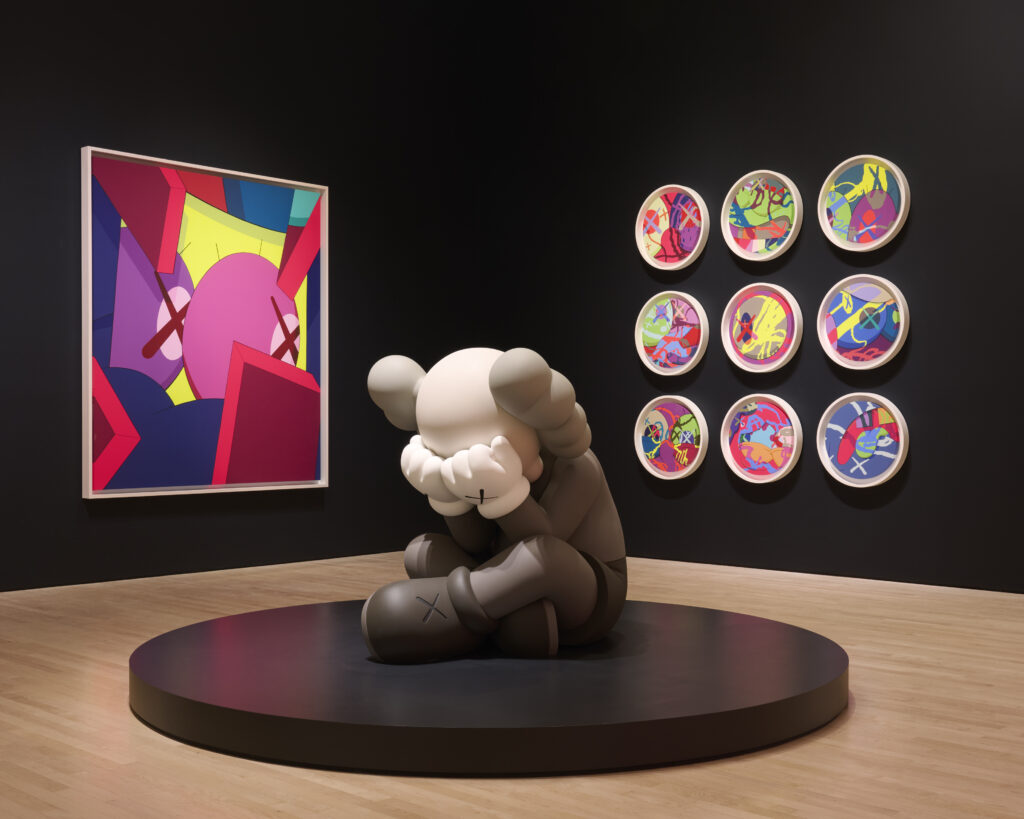
I believe that New Literalism is also pervasive in museum exhibitions. Increasingly, museums are relying on oversimplified, unambiguous work to drive audience interest. New Literalism is most visible in artists like KAWS, whose work borrows motifs from The Simpsons, Disney, Sesame Street, and other pop culture touchstones but goes no further than surface-level apolitical appropriation. Museums have come to rely on KAWS as a bankable artist whose unabashed merchandising is integral to the experience.
Where an artist doesn’t fit neatly into New Literalism, curators are happy to do the flattening themselves. In 2023 the Brooklyn Museum hosted “It’s Pablo-matic,” which reduced one of the most contradictory figures in modern art to a single, unmistakable verdict of misogynist. Whatever the merits of the charge, the show asked nothing of the viewer’s capacity to hold competing truths at once: the tension between a body of work and the man who made it, the discomfort of admiring what you might also condemn. Picasso is, in his facticity, a kind of control group for what the canon can tolerate: brazenly misogynistic yet uncancellable, fully commercialized yet still credible. That durability is exactly what makes him useful to a museum that wants the frisson of critique without the risk of ambiguity.
The constant reimagining of dead artists in presumably contemporary museums is a hallmark of New Literalism. Just this year MoMA rehashed Duchamp, leading with the question “Why is this art?” as if its job hadn’t been to answer that for the last 100 years. On the other coast, SFMOMA (where I once did some work) is trying to sensationalize Matisse’s 1905 painting Femme au chapeau as a scandal and embarking on an endless remix of mid-century modern art. SFMOMA has emerged as a leading proponent of New Literalism. In addition to the constant 20th century rehashing, it also hosted KAWS in 2024 and later this year will put on an exhibition of a K-pop superstar’s art collection.
Serpell stops short of offering an origin for New Literalism, treating it instead as a chicken-or-egg problem: did movies edit themselves to meet a dumbed-down zeitgeist, or did they actively shape it? For museums the line is easier to draw. An institution that stakes out a position (on Palestine, on policing, on who belongs in the canon) risks its donors, its board, its public funding, and sometimes its safety. Ambiguity invites discomfort, discomfort invites argument, and argument has become a liability. The safest thing a museum can now exhibit is a recognizable image that means only what it appears to mean. New Literalism, then, isn’t a failure of curatorial nerve so much as a strategy: by retreating into superficiality, museums insulate themselves from controversy while chasing the attendance that justifies their budgets. What looks like dumbing down is a deliberate disengagement from the cosmopolitan origins of the museum itself.
It is this shift toward New Literalism that opens the sector up to comparisons with blatantly superficial venues like Museum of Ice Cream or Refik Anadol’s Dataland. The fact that an amusement like Museum of Ice Cream can label itself “museum” and the public doesn’t think twice about it signals that the sector fumbled this term a long time ago. Just this week The New York Times ran an article with the headline “Who needs a museum when there’s a Banana Room?” Written by Zachary Small and Tim Schneider, the article compares the success of these immersive experiences with the attendance crisis facing museums. The message is clear: no matter how much you dumb down your museum, the Banana Room will always be dumber.
The moment requires institutions that can illuminate fraught ideas, trends, and technologies in ways a public can actually reason about. Communities across the country are absorbing the shocks of AI (data centers straining local grids, jobs disappearing, misinformation eroding any shared sense of what’s real), and almost nowhere can people turn to an institution equipped to help them think it through. This is the work museums claim as their purpose: building the literacy to read a difficult subject and the tolerance to sit with its contradictions. Instead we have Dataland, billed as the “first museum of A.I. art,” a for-profit, techno-utopian venture that propagandizes the technology while acknowledging none of the harm it has caused or the ill will it has accrued. It is New Literalism in its purest form: an unambiguous image of the future that invites its audience to take pictures rather than grapple with the societal changes the technology sets in motion.
I don’t think people stopped caring about art, and I don’t think people are disinterested in challenging ideas or in developing a nuanced view of the world around them. Art has moved on from what museums are willing to present, and instead of continuing to patronize these organizations, audiences have scattered and taken it upon themselves to “do their own research,” as the phrase now goes, for better and worse. If a museum were to seize the moment and reclaim the territory of media literacy and ambiguity, it would be rewarded by an attentive public. According to Duchamp, a work of art is incomplete until an audience interprets it; as long as museums prioritize New Literalism, the art will remain incomplete.