Choose-your-own-adventure walkthroughs for exhibitions
An unacknowledged truth in museums is that you are either an audio tour person or not an audio tour person and no amount of persuading can convince you otherwise. This is a fixed part of your identity that you’re born with like your innate fear of snakes or preference for chocolate over vanilla. Furthermore, only a vanishingly small number of people are audio guide people. This stat will vary from museum to museum, but in aggregate it holds true. A recent study by a leading provider of audio guide technology, Nubart, estimated that only 2.47% of visitors engage with audio guide apps.
What is even more demoralizing is that a lot of people spend a lot of time creating educational and contextual content for these guides that largely goes unnoticed to visitors. It is sometimes people’s entire job in a museum to make guides for exhibitions. I would argue that it’s not the content that’s unworthy, it’s the format that has not been updated in decades that has grown stale. What would an exhibition guide look like that’s updated for modern user experience? What does an exhibition guide look like that’s optimized for accessibility, repeatability, and brevity?
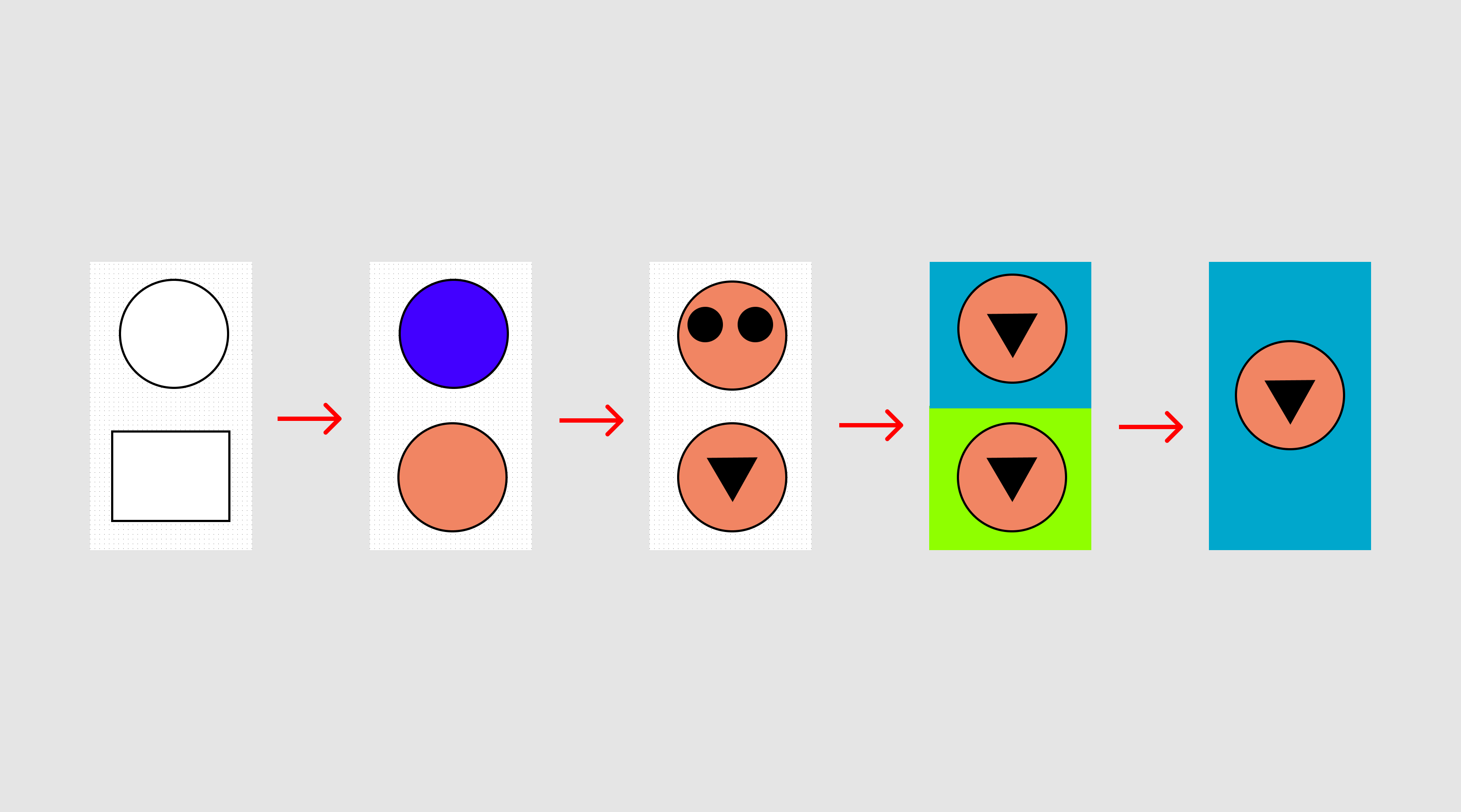
To arrive at the form I took inspiration from two sources: Wordle and the dichotomous tree often used in scientific classifications. Like Wordle, I wanted each session to take only a few minutes and provide some statistical feedback on the user’s result. The dichotomous tree would provide an uncluttered interface and many paths for a user to explore. Each path would add increasing specificity on a topic resulting in a repeatable experience that leverages spaced repetition to fix ideas and information in each user’s mind.
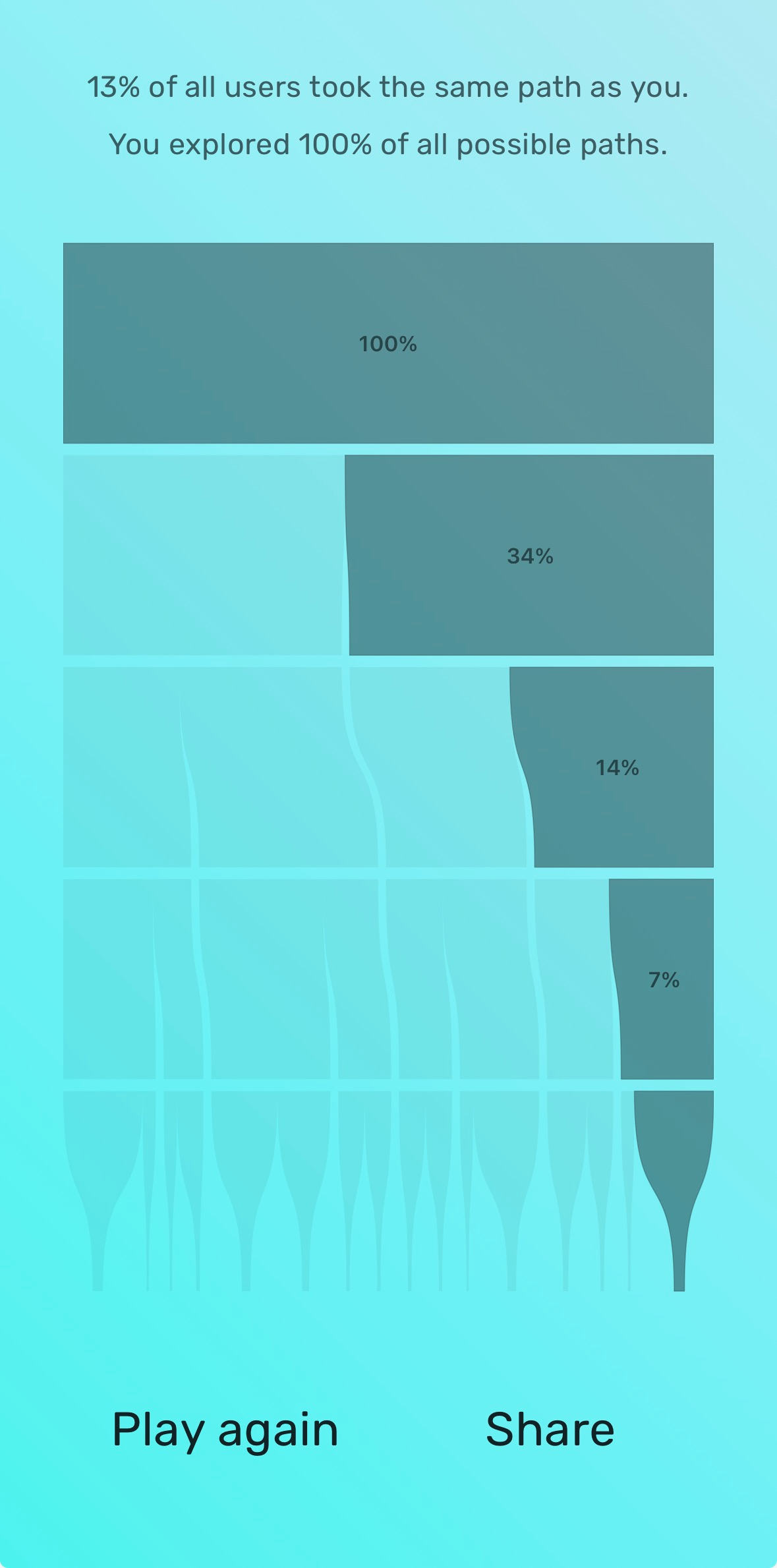
To explore this idea, I created Bosco, a choose your own adventure platform for creating guides and nonlinear exhibition walkthroughs. Bosco is an Italian name meaning forest and analogue to Bosch, the early Renaissance Dutch painter, so it seemed apropos to this project. The guides created with Bosco are quick, minimalist excursions that give a user the ability to improvise their way through a topic. At the end of a session the user is presented with a sankey diagram that shows how their path compares to other users and also the percent of total paths they have explored.
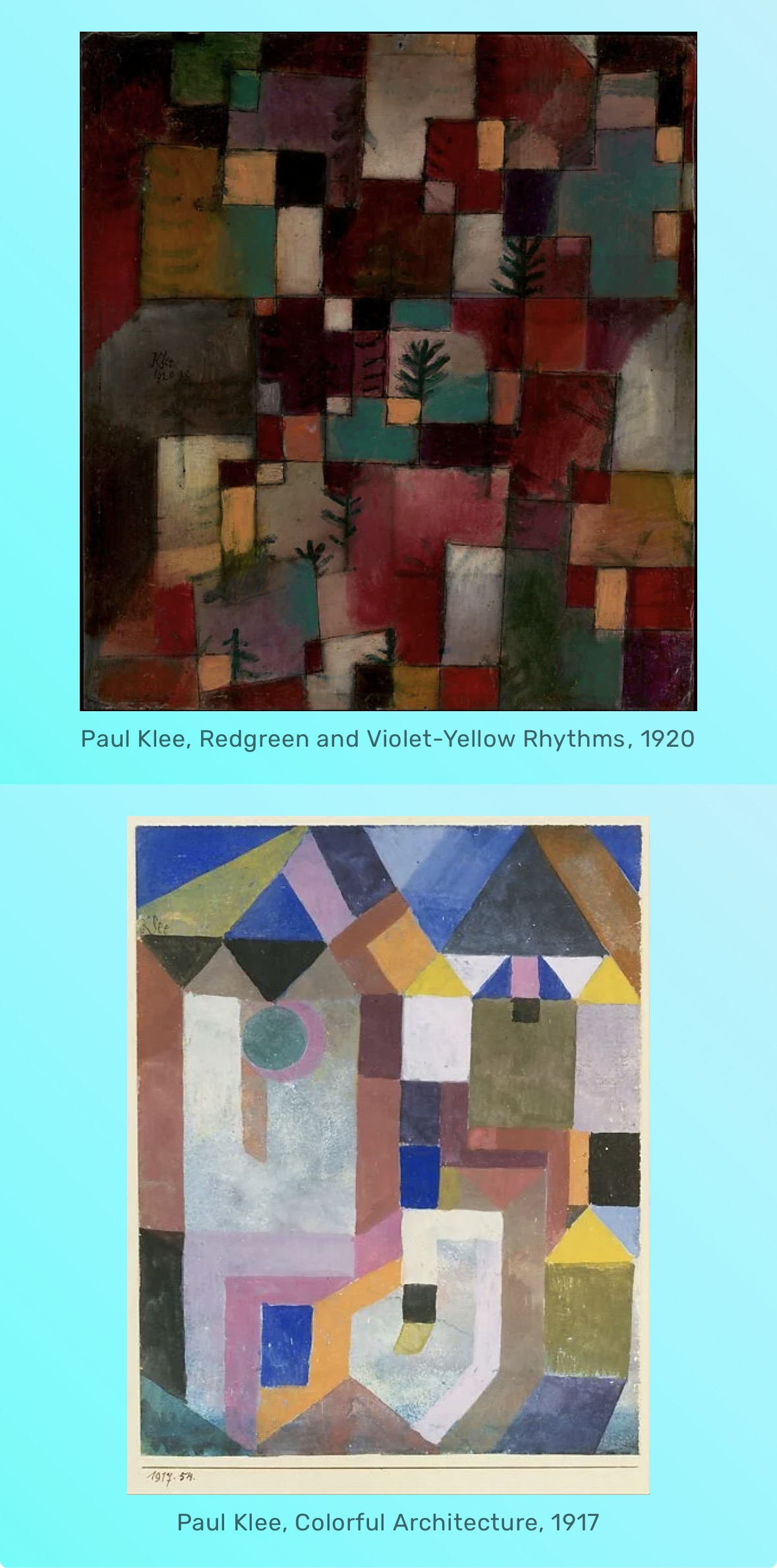
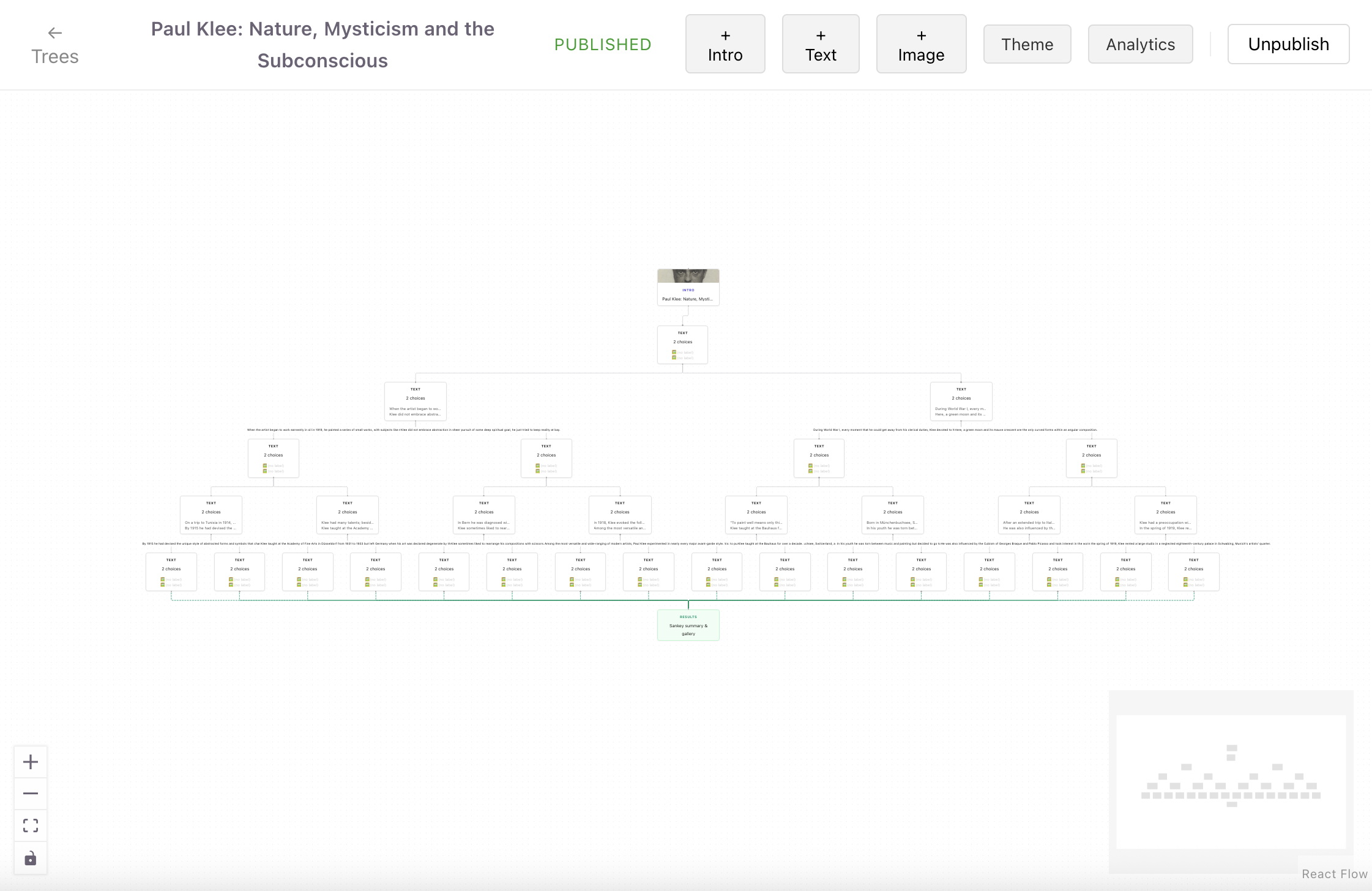
Behind the scenes an author would use a visual interface to edit and connect steps. As the tree bifurcates, choices exponentially expand. So a guide with 4 steps would have 16 possible endings and a guide with 5 steps would have 32 possible endings. An existing software that Bosco resembles is Twine, a widely beloved open source software for making interactive fiction and hypertext-based art. Bosco can also be wired up to a museum’s metadata so an author can seamlessly instantiate information about artworks, artists, exhibitions or anything else into a guide.
I can imagine many applications of this form. For multilingual guides the first step would be language selection. A museum could turn this into a PWA, or progressive web app, which brings app-like experiences to websites. A user with the Bosco installed as a PWA could download guides and use them offline, like when you put your phone in airplane mode. A museum could then send a push notification to users when a new tour is added to their Bosco instance.
 Live demo
Bosco
Choose-your-own-adventure guides for exhibitions.
Try Bosco
Live demo
Bosco
Choose-your-own-adventure guides for exhibitions.
Try BoscoThis would normally be a non-trivial endeavor for a museum. There are not a lot of applications for a tree-based content management system with drafting and versioning. But AI enabled software engineering has rendered this concern largely moot. I needed only to tell Claude that I wanted a “twine-like” experience for authoring decision trees and it spun it up mostly as I imagined it.
As it turns out, decision trees are a popular method for training AI models. To be clear, I am not advocating against the deep research and human centered content that goes into creating exhibition guides, but rather a reapplication of the materials toward a more modern interface. I personally would never trust AI with generating content, conducting research, or translating sensitive cultural content but it does allow for a rapid, iterative, and experimental approach to user experience that any museum would be smart to leverage.