How the art world prepared us for the age of AI slop.
This past summer my fellow fellow at Harvard’s Berkman Klein Center for Internet & Society, Jeffrey Snover, described LLMs succinctly in his blog post “LLM Models Are Bullshit Engines”: they generate text without any care for veracity. Truth is inconsequential to output.
“It produces plausible-shaped text with total indifference to whether the world matches. When it’s right, it’s right as a side effect of its training data, not out of conviction. When it’s wrong, it’s wrong with exactly the same confidence and exactly the same beautiful prose.
That’s not a bug in the model. That is the model.”
After reading Jeffrey’s post my spidey-sense was tingling. Framed this way, LLMs had a clear precedent that not only predicted but enabled their proliferation.
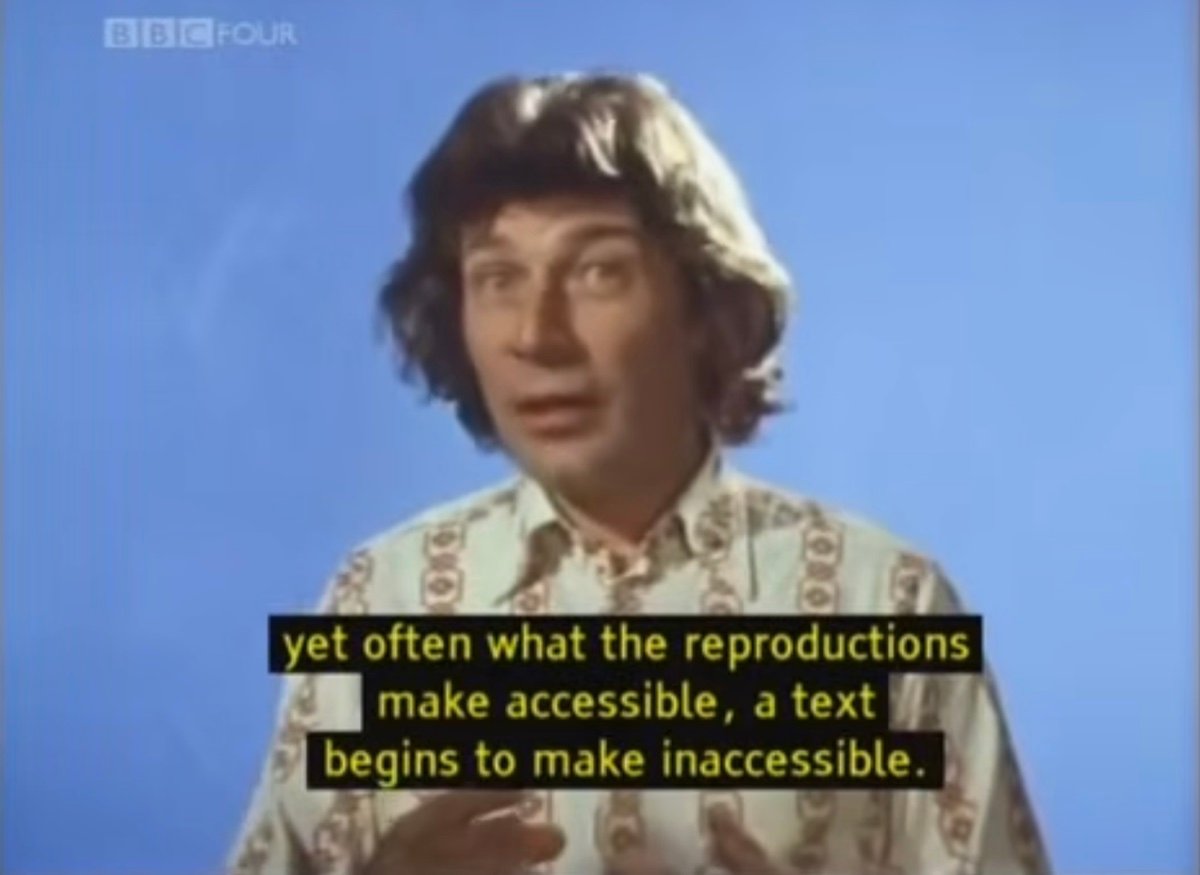
Back in 1972, on the first episode of his seminal BBC series “Ways of Seeing,” John Berger considered the “false mystification that surrounds art.” He argued that the accessibility of print reproductions of art is often negated by the inaccessibility (i.e. opaqueness) of the text that accompanies them. Half a century ago, Berger blamed this on academics and experts trying to maintain a sort of hegemony over their subject. Today this has been fully professionalized and is considered an intrinsic quality of art. No artwork or exhibition is expected to stand on its own without being accompanied by arguably meaningless text.
In 2012 Triple Canopy published the essay “International Art English” by Alix Rule and David Levine. In it, the authors outline an emergent vernacular of coded English meant to facilitate class solidarity through a shifting linguistic game.
The authors begin by saying of International Art English (IAE): “Its purest articulation is found in the digital press release.” In other words, without the physical constraints of print, this language could develop at an accelerated pace. The internet enabled this. As IAE emerged, so did its unwritten rules and standards, which a fluent practitioner could use to produce voluminous amounts of text without saying much of anything at all. Or, as Jeffrey puts it, with “total indifference to whether the world matches.”
Working at SFMOMA in the 2010s, I once ran a spate of exhibition texts written by curators through a natural language processor to estimate the average reading level of this corpus. The results came back pretty much off the chart: museum curatorial text was more complex than legal speak. It was a category so blindingly opaque that one must assume its only function was to put words on the page. Unlike legalese, the complexity wasn’t there to make anything more precise. It was there to signal membership.
The endless press releases of IAE produced throughout this century inevitably went on to train the models that have entered our daily lives. Whether we use them personally or read things on the internet, we have encountered the output of LLMs. But the more insidious outcome was that IAE trained us to accept text that is shaped like it has meaning but in reality has none, long before LLMs began producing it.
This week I learned that “International Art English” is Triple Canopy’s most popular post ever. This indicates that the essay put a name to something the general public had been feeling for quite some time. Instead of recognizing this as an opportunity to rethink arts communication, the galleries, museums, and PR agencies just plowed on. By then, art speak had become a profession, with its own job titles, skill sets, and budget lines, and a profession rarely questions its own product.
Every so often, though, an image cuts through the bullshit. When Maurizio Cattelan duct-taped a banana to a wall at Art Basel Miami Beach in 2019, it laid bare just how pointless all this IAE is.
As LLMs become more prevalent, we are all playing a game of suspicions, its rules determined without our knowledge and now taken out of our hands altogether, to be developed by machines that have no idea of art, let alone an ability to appreciate it.
We are left sipping wine of unknown provenance, trying to convince each other of the notes we detect.